
A strong manufacturing website does more than look modern. This review of manufacturing website examples shows how industrial sites help buyers identify capabilities, verify technical fit, find useful proof, and choose a sensible next step.
This analysis reviews five public websites as checked again on August 28, 2026. It does not rank the companies and does not imply affiliation or endorsement. The goal is to identify structural lessons that a smaller manufacturer can adapt without copying another brand, page, or interface.
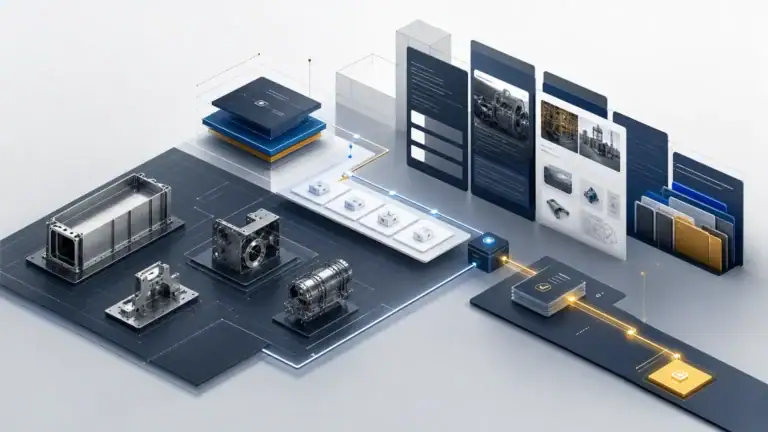
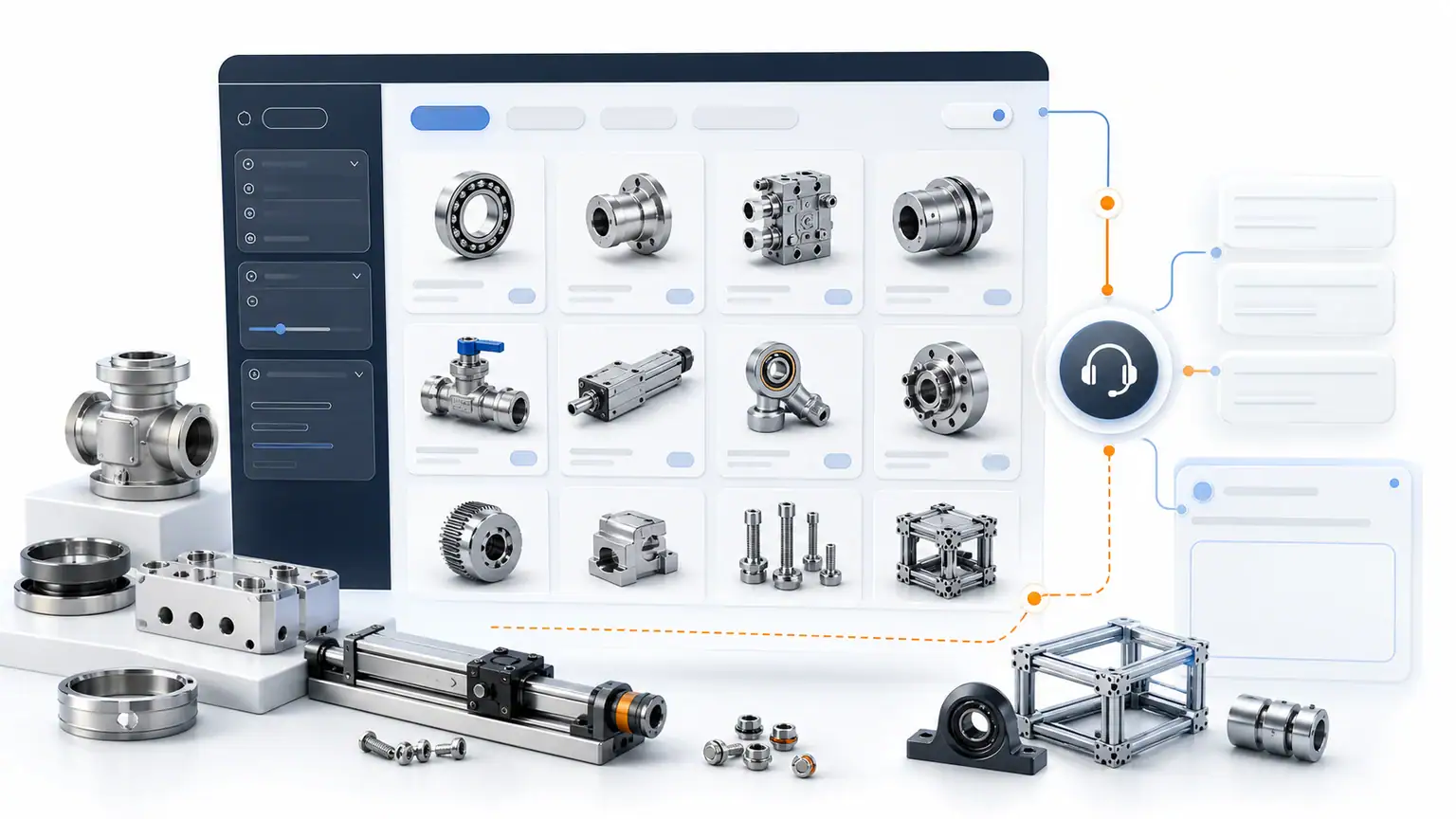
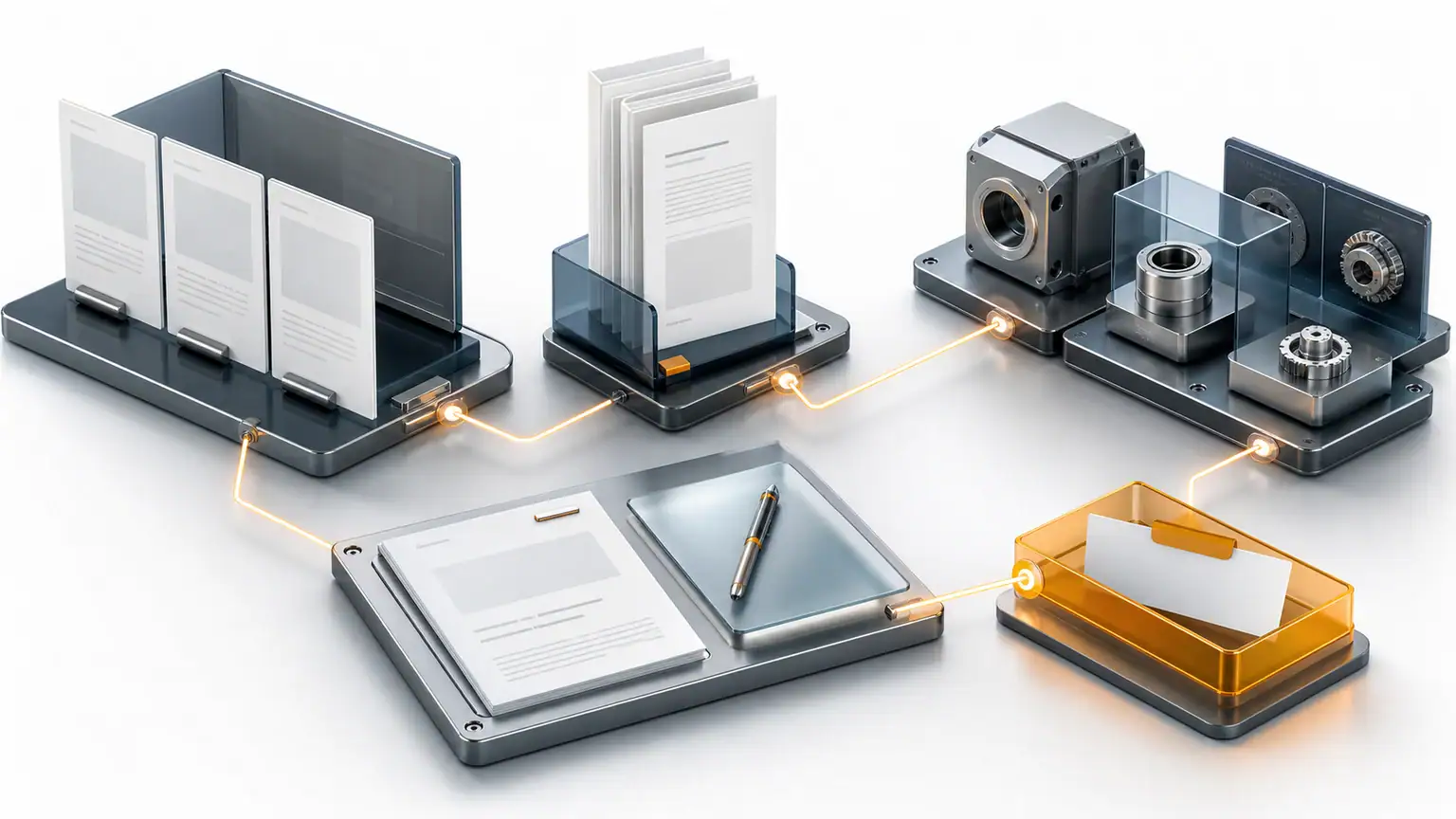
All illustrations in this article, including the featured image, are AI-generated and do not depict any real website or facility.
Key takeaway
A useful manufacturing website does not try to display everything on one page. It organizes the decision: understand the offer, verify technical fit, find proof, and start a qualified inquiry.
How we evaluated these manufacturing websites
We used four practical criteria that apply to both smaller industrial firms and global manufacturers:
- Capability clarity: can a buyer quickly understand what the company makes, integrates, or solves?
- Product discovery: can users filter, compare, and find useful technical information without knowing the company’s internal structure?
- Proof and resources: do applications, case studies, documentation, or services make expertise easier to verify?
- Next step: can the buyer request a quote, reach an expert, find a distributor, or continue the evaluation?
This article stays intentionally narrower than our guide to manufacturing website design and SEO. That guide explains what to build; this one studies how five public sites organize buyer decisions.
What should a manufacturing website help buyers do?
A manufacturing website should help a buyer answer four questions: can this company handle the requirement, what proof can be verified, which technical constraints matter, and what is the right next step? For a smaller manufacturer, the priority is not page count. It is a clear connection between capabilities, applications, documents, proof, and the inquiry path.
Quick comparison: five examples and one lesson from each
| Website observed | Visible strength | Lesson for a smaller manufacturer |
|---|---|---|
| Protolabs | Digital quote and expert-assisted path | Offer different paths for different project maturity |
| Schneider Electric | Solutions, insight, customer stories, and locations | Separate buyer needs without fragmenting the brand |
| Festo | Deep catalog and technical support | Use the buyer’s vocabulary in filters and categories |
| KUKA | Tools, applications, and customer projects | Turn expertise into decision support |
| Caterpillar | Products, parts, services, and support | Make the post-sale lifecycle visible before the sale |
The five websites are listed in no particular order. This analysis does not rank them.
Protolabs: two quote paths for two levels of project maturity
Protolabs separates an instant online quote from a production-team conversation. Its homepage also organizes CNC machining, injection molding, 3D printing, and sheet metal services while connecting prototyping to production. A buyer with a ready file therefore does not have to follow the same path as a program that still needs framing. View Protolabs.com [1]
Adapt this: do not force every prospect into one generic form. Provide a fast route for a defined requirement and a guided route for a complex project.
Schneider Electric: organize a broad offer without becoming only a catalog
Schneider Electric combines access to solutions, insight content, customer stories, and a global directory. Not every visitor must begin with a product reference: some arrive through a business problem, an industry, a need for proof, or a local contact requirement. View se.com [2]
Adapt this: a smaller manufacturer can use a compact version with three clear routes — capabilities, industries served, and real applications.
Festo: make a technical catalog genuinely explorable
Festo presents detailed product families, automation solutions, and access to virtual assistance for installation, troubleshooting, and technical information. The lesson is not the size of the catalog. It is the effort to convert technical depth into explicit paths a visitor can explore. View festo.com [3]
Adapt this: name categories the way buyers describe their requirements. Internal department names, product codes, and workshop terminology are not always useful entry points.
KUKA: turn expertise into tools and application scenarios
KUKA connects robotics solutions with industries, customer projects, technical articles, and an autonomous mobile robot fleet calculator. This gives a buyer a way to make progress before a sales conversation while creating better context for the eventual inquiry. View kuka.com [4]
Adapt this: you do not need a complex calculator. A decision matrix, qualification questionnaire, or application comparison can make specialist knowledge actionable.
Caterpillar: extend the website beyond the first purchase
Caterpillar separates equipment, power systems, attachments, and parts, then highlights financing, maintenance, repairs, and support. The journey recognizes that an industrial buyer evaluates availability, service, and operating continuity as well as the machine itself. View cat.com [5]
Adapt this: do not let every page end at “contact us.” Explain what happens after the order — onboarding, documentation, commissioning, service, parts, training, or ongoing support.
Five shared principles worth adapting
- Start with an understandable value proposition. The buyer should recognize the problem and the solution before encountering internal jargon.
- Place proof near the promise. Applications, capabilities, documents, and customer evidence should appear when a question arises.
- Organize around decisions. Products, industries, resources, and services serve different buyer tasks.
- Offer more than one sensible next step. A quote, expert conversation, distributor search, or technical resource can coexist without aggressive CTA clutter.
- Make the post-sale path visible. Support and continuity build confidence before a contract is signed.
What a smaller manufacturer should not copy
A global company can support hundreds of categories, multiple search tools, and several navigation layers. A smaller manufacturer that copies that density may hide its advantages. The objective is not to imitate scale. It is to adopt the discipline: a clear promise, verifiable proof, and a coherent inquiry path.
Avoid unsupported superlatives, unauthorized customer logos, unexplained certification claims, and generic imagery presented as evidence of a real facility.
How to turn these examples into a practical project brief
Do not begin by asking a designer to reproduce the visual style of one of these websites. Begin with buyer tasks. List the questions an engineer, procurement lead, distributor, or executive must answer before starting a conversation. Then map each question to a page, proof item, technical resource, or inquiry step.
Use the five examples as prompts rather than templates. Protolabs can inspire a split between self-service and expert-assisted inquiries. Festo can prompt a review of product filters. KUKA can inspire a lightweight decision tool. Caterpillar can reveal missing post-sale information. Schneider Electric can help separate solution, industry, and insight paths. The resulting brief should fit your actual market, evidence, team capacity, and sales process.
Checklist: does your manufacturing website help buyers move forward?
- A buyer can understand your core capabilities in less than a minute.
- Industries and applications connect to relevant products or services.
- Useful specifications, materials, tolerances, or constraints are easy to find.
- Proof is real, current, and authorized.
- There is one path for a defined requirement and another for a project that needs framing.
- The inquiry form requests only what is needed for the next step.
- Commissioning, support, parts, or ongoing service are explained.
- The mobile experience preserves essential filters, resources, and calls to action.
If several answers are no, analyze the buyer journey and existing proof before choosing a new visual design. The AUTOM7 free website audit can identify initial priorities without promising automatic growth.
Official sources consulted
- Protolabs — rapid prototyping and production services (accessed August 28, 2026).
- Schneider Electric — global website (accessed August 28, 2026).
- Festo USA — pneumatic and electric automation (accessed August 28, 2026).
- KUKA — automation solutions (accessed August 28, 2026).
- Caterpillar — products and services (accessed August 28, 2026).
Frequently asked questions
What makes a good manufacturing website?
It helps a buyer understand capabilities, verify technical fit, find proof, and choose the right next step.
Should the homepage display the entire product catalog?
No. The homepage should orient the visitor. Products, applications, and resources can then live in focused paths.
Are the companies in this article AUTOM7 clients?
No. They are public websites observed for editorial analysis. No affiliation or endorsement is implied.
Can a smaller manufacturer apply these lessons with fewer pages?
Yes. A compact structure around capabilities, industries, proof, resources, and inquiries can be clearer than a large catalog.
Where should a website redesign start?
Inventory useful pages, available proof, buyer needs, and current conversions. Then decide what should be preserved, clarified, or rebuilt.
Does your manufacturing website help serious buyers move forward?
Identify the first useful improvements to clarity, proof, and the inquiry path.