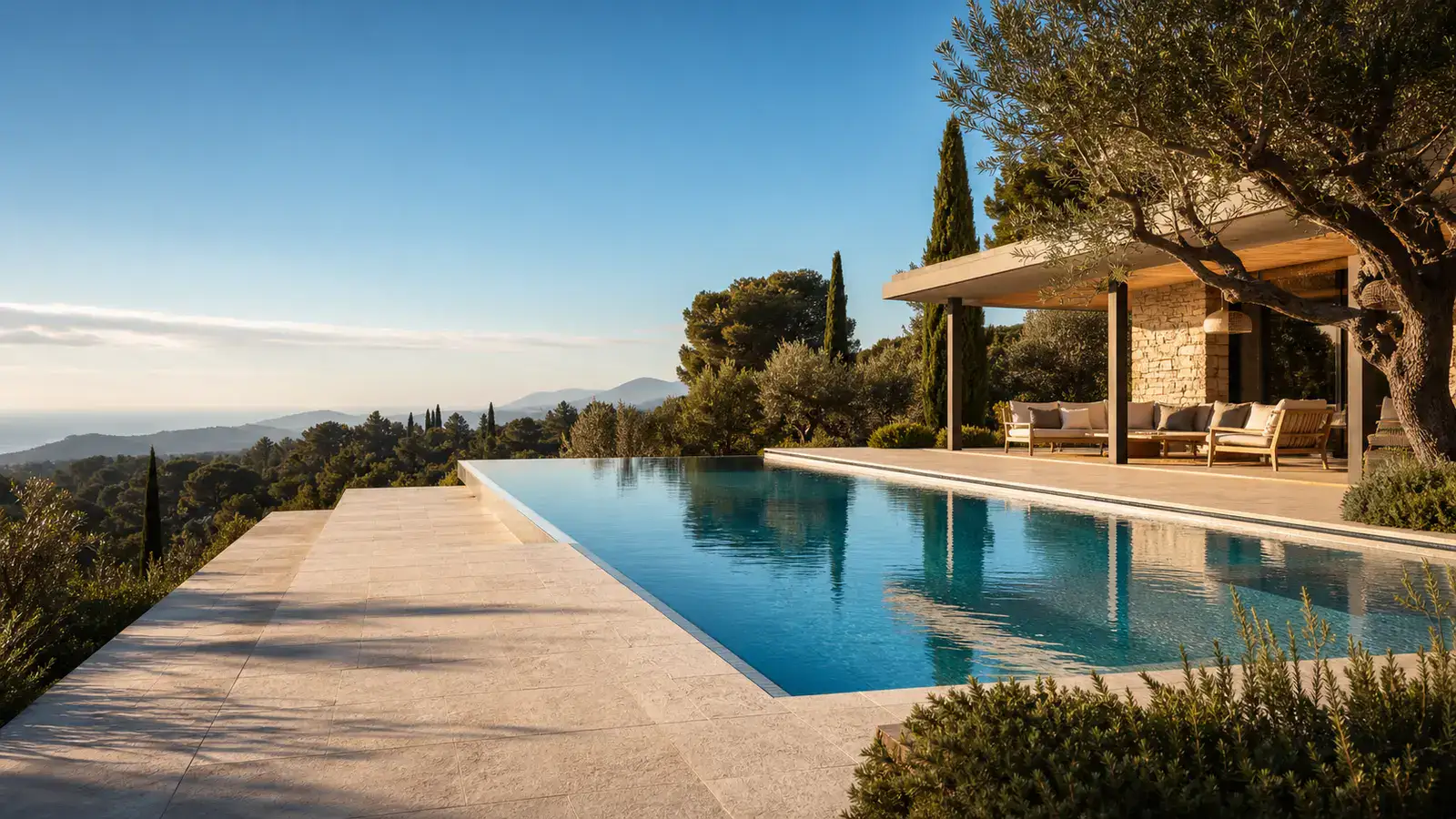
A homeowner planning a swimming pool is not looking only for a basin. They are looking for a professional who can understand the site, explain the technical choices, show comparable projects and support the work through commissioning. Your website should make that value clear before the first call.
Pool builder website design is therefore not a matter of placing a few attractive photographs on a homepage. The commercial objective is to build an asset: a website that reassures prospects, helps them find the right information, demonstrates your expertise and turns genuine interest into qualified quote requests.
The key takeaway
A good-looking site catches the eye. A well-planned site helps prospects understand your difference, recognise the kind of project they want and take the next step without hesitation.
What a prospective client should understand within seconds
On arrival, a visitor should quickly be able to answer four questions: where do you work, what kinds of projects do you deliver, why should they trust you and how can they request an initial assessment? When those answers are scattered or hidden, the website makes the prospect work unnecessarily hard.
The opening section should present a clear promise, an understandable service area, visual evidence and one coherent next action. The goal is not to pile up arguments. It is to give visitors a clear path to the information they need.
- Your services: new pool construction, renovation, maintenance, equipment or complete project support.
- Your territory: the towns, county, state, region or practical radius you genuinely serve.
- Your position: family pools, premium landscape-led projects, technical renovation, recurring maintenance or another clear specialty.
- The next step: request an assessment, arrange a conversation or describe the project.
Seven elements of an effective pool builder website
1. A homepage that directs instead of trying to say everything
The homepage should present the essentials and then direct each visitor to the relevant page: construction, renovation, maintenance, completed projects or contact. A long list of services without hierarchy makes the offer harder to understand.
2. Separate pages for your important services
In a pool builder website project, one generic “Services” page is rarely enough to explain very different jobs. A new build, an existing-pool renovation, a filtration-system replacement and a maintenance agreement do not raise the same questions. Dedicated pages let you explain the process, constraints, options and evidence relevant to each search intent. A French pool-industry guide likewise recommends defining the company, product or service, gallery and contact pages before the build begins.[1]
3. A documented project portfolio
Photographs matter, but they become far more useful when they are accompanied by context. Explain the original requirement, the site conditions, the choices made, the constraints resolved and the finished result. A documented project helps visitors imagine their own outcome more effectively than an anonymous gallery.
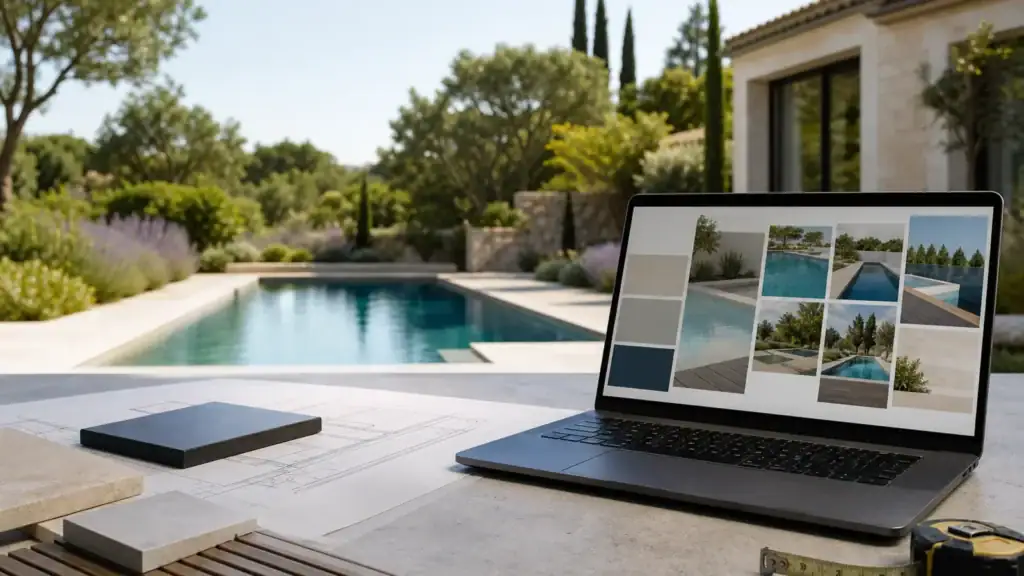
Organise projects in a way that supports buying decisions: new builds, renovations, compact sites, lap pools, landscaping integration or location. Sophisticated filters are useful only when the project volume justifies them; simple navigation comes first.
4. Concrete, verifiable evidence
Genuine reviews, certifications actually held, applicable warranties, named partners, years of experience and real site photographs can all reduce uncertainty. Each item should remain precise and verifiable. Avoid superlatives you cannot demonstrate and numbers without evidence.
5. A well-prepared quote-request journey
A form that is too short can produce enquiries that are difficult to qualify, while an endless form discourages people. Ask only for information that helps prepare the conversation: location, project type, expected timing, the current condition of the site or pool, and the preferred contact method.
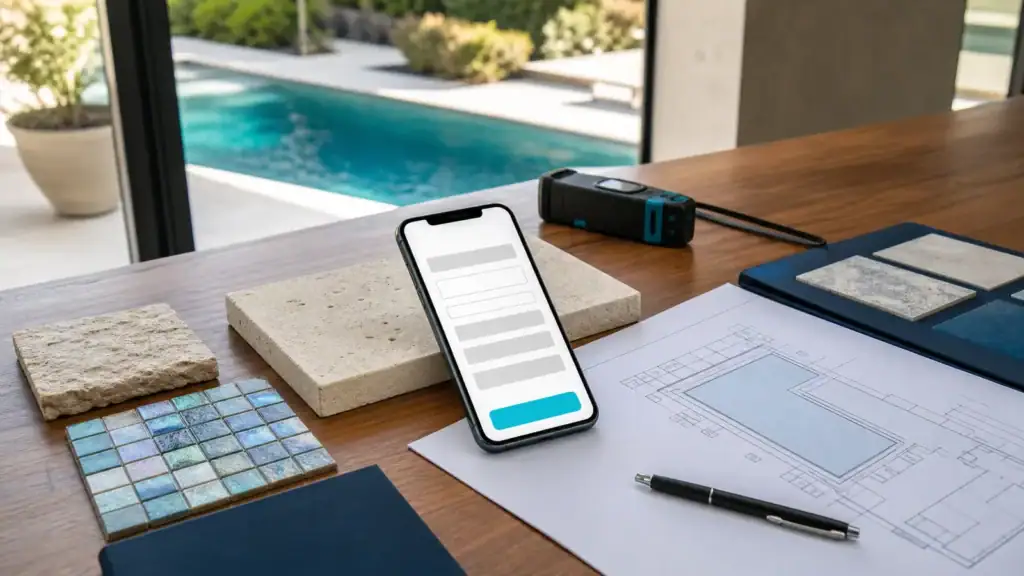
Explain what happens after submission. The prospect should know whether to expect a call, a request for photographs, a technical visit or an initial meeting.
6. A fast, readable mobile experience
A homeowner may discover your business on a phone, compare several providers and send site photographs on the same day. Text needs to remain readable, buttons easy to use and galleries light enough to load comfortably. Speed is not a decorative technical metric; it affects the visitor’s experience.
7. Measurement that improves the website over time
A website is not finished on launch day. Track the pages people visit, forms submitted, calls attributed to the site and queries visible in Google Search Console. The pool-industry source also recommends web analytics to understand which pages and products attract interest and whether visitors reach the contact form.[1] These signals help you improve pages that matter to prospects instead of publishing content at random.
Turn completed projects into genuine trust pages
Pool builder website design becomes more credible when completed work is presented as commercial evidence rather than decoration. Each project can support a buying decision when the presentation respects the client and exposes no private information.
A useful project page can include:
- a concise description of the original requirement;
- the type of pool, renovation or maintenance work;
- the main site constraints;
- the chosen solutions and the reasoning behind them;
- before, during and after photographs when the client has authorised their use;
- a geographic area described at an appropriate level; and
- a call to action for a similar project assessment.
This approach improves trust, explains the depth of your work and supports local visibility while avoiding generic articles that show nothing about the business’s real capability.
Local SEO: make your service area understandable
For a pool builder, local SEO depends on consistency between the website, the Google Business Profile, business details, service pages and locally relevant completed projects. Repeating a list of towns in every paragraph does not create that consistency.
Start with a clear description of the area you genuinely serve. Add location-specific material only when you have something useful to say: completed work, soil or access constraints, local planning considerations within your competence, existing-pool renovation needs or questions prospects repeatedly ask in that area.
Titles, descriptions, internal links and structured data should help search engines understand the business. Google’s own starter guide recommends unique, clear page titles, useful well-organised content, descriptive link text and meaningful image alt text.[2] No isolated setting replaces a clear offer, credible evidence and pages that answer customer questions. AUTOM7 does not guarantee a Google position, enquiry volume or revenue. The work focuses on controllable elements: clarity, page quality, evidence, measurement, testing and continuous improvement.
Build a commercial journey, not a passive brochure
A pool builder website can attract traffic without producing suitable enquiries when the journey is poorly defined. A useful commercial system connects each stage:
- Discover: a service page or completed project answers the search.
- Understand: the visitor identifies your approach, territory and services.
- Gain confidence: they review projects, evidence, a clear process and specific answers.
- Act: they find an appropriate form or conversation route.
- Receive follow-up: the enquiry reaches the right person and receives an organised response.
The final stage deserves as much attention as the design. A missed notification, a poorly routed enquiry or a late response reduces the website’s value. Depending on the business, a form can feed a CRM, create a task or notify the responsible person while preserving human control.
Does your website genuinely guide visitors towards a quote request?
The AUTOM7 mini-diagnostic checks visible first signals: offer clarity, calls to action, evidence, contact routes and page structure.
How to scope a pool builder website project
Budget and timing depend mainly on the real scope. Before comparing proposals, check what is included: strategy, page structure, copywriting, photography, integration, baseline SEO, conversion measurement, maintenance and post-launch support.
A very low monthly price may suit a simple presence, but review who owns the website, how it can evolve, the quality of the content and the exit conditions. A more complete project makes sense only when the pages, evidence and follow-up support a concrete commercial objective.
Ask prospective providers questions such as:
- How will you understand our services and service area?
- Who writes the pages, and how are claims checked?
- How will our completed projects be structured?
- How will quote requests be received and followed up?
- What will we be able to change ourselves?
- What checks will be carried out for mobile, speed and search visibility?
- What happens after launch?
The AUTOM7 approach to pool builder website design
AUTOM7 starts with the business and customer journey before choosing tools. The work begins with the offer, priority territories, available project evidence and the contact path. The website structure is then built around those elements.
The goal is not to turn the pool builder into a web technician. The site should remain manageable, adaptable and connected to useful operations: enquiry receipt, follow-up, content, measurement and improvement. Artificial intelligence can assist research, production or analysis, but commercial decisions and approval remain human-led.
You can review AUTOM7 services or describe your project directly to Geoffroy Toussaint. The initial conversation is for understanding and scoping the need, not for forcing a technical solution.
How many pages does a pool builder website need?
There is no universal number. The website should at least distinguish important services, completed projects, the service area, the business and contact. The right scope depends on positioning and the range of projects.
Should a pool builder create a page for every town?
Only when a page provides genuinely useful local information and represents an area the business really serves. Duplicating the same text and changing only the town name gives visitors little value.
Are project photographs enough?
They are important, but they become more persuasive with context: the requirement, constraints, choices, stages and result. Obtain the necessary permissions before publication.
How long does pool builder SEO take to produce results?
Timing depends on the website, local market, competition, domain history and content quality. Track real Search Console signals and received enquiries instead of promising a date or ranking.
Frequently asked questions
How many pages does a pool builder website need?
There is no universal number. The website should at least distinguish important services, completed projects, the service area, the business and contact. The right scope depends on positioning and the range of projects.
Should a pool builder create a page for every town?
Only when a page provides genuinely useful local information and represents an area the business really serves. Duplicating the same text and changing only the town name gives visitors little value.
Are project photographs enough?
They are important, but they become more persuasive with context: the requirement, constraints, choices, stages and result. Obtain the necessary permissions before publication.
How long does pool builder SEO take to produce results?
Timing depends on the website, local market, competition, domain history and content quality. Track real Search Console signals and received enquiries instead of promising a date or ranking.
Review your current website before committing to a complete redesign
Check the first visible obstacles for free: offer clarity, trust signals, contact paths and page structure.
Sources
- Guide-Piscine.fr — Les 5 étapes de création de votre site internet pisciniste (French pool-industry resource; accessed 18 September 2026).
- Google Search Central — SEO Starter Guide (accessed 18 September 2026).