
A B2B manufacturing website has one job before it has a design job: help a serious buyer decide whether your company deserves the next conversation.
That buyer may be an engineer checking tolerances, a procurement manager comparing suppliers, a distributor looking for product fit, or a managing director trying to reduce dependence on referrals and trade shows. They are not browsing for decoration. They are trying to answer practical questions.
- Can this company make or solve what we need?
- Do they understand our industry and constraints?
- Can we find proof without booking a call first?
- Is it easy to request a quote, send context, or start a serious discussion?
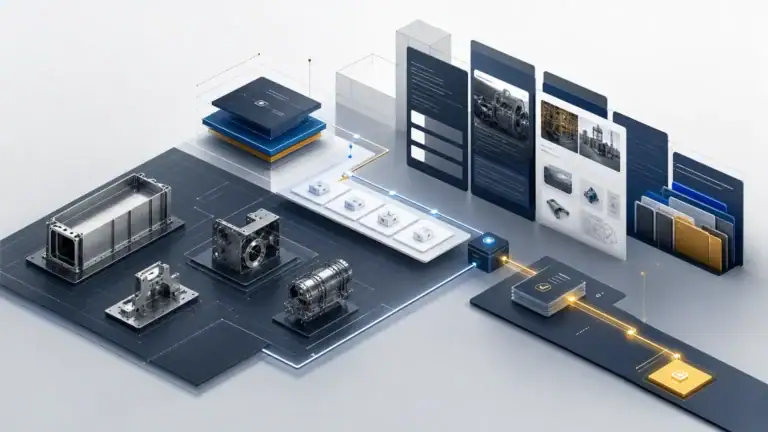
This is why manufacturing website design and SEO belong together. In practice, manufacturing website design and SEO should make capabilities, proof, RFQ paths and commercial next steps easier for technical buyers to understand before they contact sales.
If the site only looks modern but does not explain capabilities, proof, applications and next steps, it is still a brochure. A better goal is to build a commercial asset: a website that supports supplier evaluation before sales ever gets involved.
Industrial buyers do not read websites like consumers
Consumer websites often sell emotion first. Industrial B2B websites have to reduce risk first.
Technical buyers may want different things. An engineer may want specifications, material limits, accepted file types, process details or certification context. Procurement may want proof that the supplier is reliable enough to shortlist. A sales director may want the website to explain the company clearly before a call. Each person arrives with a different task, but most manufacturing websites give them the same generic path.
That mismatch is expensive. Gartner reported that 61% of B2B buyers prefer an overall rep-free buying experience, based on a 2024 survey of 632 B2B buyers. The study covers B2B broadly, not manufacturing only, but the self-service pattern matters even more when technical buyers need to validate suppliers before a call. The same release also noted that 69% of buyers reported inconsistencies between the information on a sales organization’s website and what sellers provided. In plain terms: buyers want to self-educate, and inconsistent website content can create mistrust. Gartner source.
For manufacturers, that means the website cannot be treated as a side asset. It is part of the sales process. If it hides the answers buyers need, the company may be removed from the shortlist before anyone on the team knows the opportunity existed.
What most manufacturing websites get wrong
The problem is rarely only the visual design. Plenty of industrial websites look clean and still fail to help buyers. The common issue is structure.

They organize around the company, not the buyer
Manufacturers often organize navigation around internal departments, product families, or legacy catalog names. Buyers usually think differently. They search by application, process, material, problem, tolerance, region, certification, delivery need or industry.
If your buyer searches for a process and lands on a vague “Solutions” page, the site creates work instead of removing it.
They rely on history instead of proof
A founding year can support trust, but it is not a value proposition. A buyer needs to know what you make, what you handle, where you are strong, and what kind of project fits your operation.
Better proof includes real equipment photos, certifications with context, named industries, project examples, quality process, capacity, accepted file formats, inspection capability and clear application limits.
They make RFQs feel like an admin task
Many RFQ forms ask too much, too early, or too vaguely. Others are buried behind a generic contact page. A good manufacturing website makes the next step feel natural: upload a file, describe the part, select a process, request an audit, book a conversation, or ask for a quote.
The buyer should not have to guess what happens after submitting the form.
The pages a manufacturing website usually needs
A strong industrial website is not built from one homepage and a few service blurbs. It needs a map that matches how buyers evaluate suppliers.
- Capability pages for the processes or services buyers search for.
- Application pages for use cases, environments or technical problems.
- Industry pages when different sectors need different proof.
- Proof pages for case studies, equipment, certifications and quality process.
- Commercial pages that explain scope, pricing logic, timelines and next steps.
- Support articles that answer the questions buyers ask before contacting sales.
This structure helps SEO because each page has a clearer purpose. It also helps sales because the site starts answering questions that would otherwise slow down the first call.

The mistake is to create one article for every keyword variation. Variants with the same intent usually belong on the same page as sections, examples or FAQs. A separate page is justified only when the intent, buyer task and business role are different.
How SEO supports qualified RFQs
Manufacturing SEO should not chase traffic for its own sake. A smaller number of qualified technical searches can matter more than a large volume of generic visits.
The useful question is not “What keyword has volume?” but “What page would help a buyer move closer to a real enquiry?”
Good manufacturing SEO and technical SEO for manufacturers usually connect four things:
- the language buyers use in search;
- the company’s real capabilities and limits;
- the page type Google already rewards for that intent;
- the next commercial step the visitor should take.
For example, a query about “manufacturing website design” does not need a generic definition only. The reader is often trying to understand what a serious industrial website should include, how it affects leads and RFQs, what it may cost, and whether a specialist partner is needed. That is why a serious guide has to go beyond a definition: it should cover what to include, what the scope can cost, and when a specialist partner is worth considering.
What design has to make visible
Good industrial website design is not decoration. It makes technical and commercial confidence visible.
Clarity in the first screen
The first screen should explain what the company does, for whom, and what action a serious visitor can take. A large facility photo and a slogan are not enough.
Proof near the decision point
Certifications, process proof, equipment, industries served and project examples should appear close to the sections where buyers are making decisions. Proof hidden in a footer or a PDF library rarely works hard enough.
Technical content that is easy to scan
Tables, diagrams, short sections, downloadable documents, comparison blocks and filtered product information can make complex expertise easier to evaluate. The goal is not to oversimplify; it is to remove friction.
Mobile that respects real buying behavior
Industrial buyers still open supplier websites on phones: between meetings, on site, during travel, or while checking a shortlist. If tables break, PDFs are unreadable, or forms are painful, the mobile version is costing opportunities.
What a serious manufacturing website can cost
There is no single honest price for a manufacturing website because the scope can be completely different from one company to another. A small fabrication shop that needs 12 clear pages is not the same project as a manufacturer with a product catalog, document library, multilingual content, RFQ workflow and ERP integration.
Public pricing guides from manufacturing-focused agencies show how wide the market can be. Nopio, for example, describes these broad market tiers: Nopio pricing guide.
| Project scope | Indicative market range | Typical need |
|---|---|---|
| Basic brochure site | $10,000-$25,000 | Credibility, services, contact path, basic SEO |
| Product catalog site | $25,000-$50,000 | Products, specifications, filtering, document downloads |
| B2B e-commerce or RFQ platform | $50,000-$100,000+ | RFQ systems, account logic, pricing context, quote workflows |
| Enterprise custom build | $100,000+ | ERP, CRM or PIM integrations, multilingual architecture, complex taxonomies |
Those ranges are not AUTOM7 pricing. They are useful market context. They show why “website cost” is the wrong first question. The better question is: what does the website need to do for buyers, sales and operations?
The main cost drivers are usually:
- number and complexity of capability pages;
- product catalog or document library depth;
- RFQ forms, file uploads or quoting workflows;
- CRM, ERP or PIM integrations;
- technical writing, photography, diagrams and proof assets;
- multilingual architecture;
- ongoing SEO, reporting and content improvement.
A manufacturer that only needs a clearer brochure site should not pay for enterprise architecture. A manufacturer that needs product data, technical documents and structured RFQ routing should not buy a cheap template and expect it to behave like a sales system.
Expert note — Geoffroy Toussaint
In manufacturing, the website should not simply prove that the company exists. It should reduce the buyer’s perceived risk before the first call: what you do, where you are strong, what proof exists, and what happens after an RFQ.
— Geoffroy Toussaint, AUTOM7 solutions architect
Where AI and automation belong
AI can help an industrial website, but it should not become a public gimmick or an uncontrolled publishing machine. The safest role is controlled support behind the commercial system.
For a manufacturing company, AI and automation can help with:
- turning technical notes into clearer draft content for review;
- clustering buyer questions into page ideas;
- detecting missing capability or application pages;
- summarizing RFQ submissions before sales follow-up;
- routing enquiries to the right person;
- monitoring pages that need refresh;
- creating recurring SEO and lead-quality reports.
The key word is controlled. Technical accuracy and reputation still need human review. AI should make the system faster and more consistent, not replace judgment where a wrong answer can damage trust.
How AUTOM7 approaches a manufacturing website
AUTOM7 treats the website as part of the commercial engine, not as an isolated design project.
The starting point is an audit: what the current site says, what buyers need to know, where SEO demand overlaps with sales value, which pages are missing, and where the conversion path is weak.
From there, the work usually becomes a sequence:
- map the real buyer journey;
- clarify positioning and page architecture;
- create or improve capability, application and proof pages;
- connect SEO topics to business value;
- build better calls to action and RFQ paths;
- add controlled automation where it saves time or improves follow-up;
- measure what changes in Search Console, analytics and enquiries.
This is different from buying a prettier website. A prettier website may help first impressions. A real sales asset helps the buyer understand, trust and act.
Turn your manufacturing website into a sales asset
AUTOM7 reviews clarity, buyer proof, SEO structure, RFQ paths and automation opportunities before recommending a redesign or content plan.
Get my free auditFrequently asked questions
For a machining-specific view, see our machine shop website design guide on capability pages, buyer proof and RFQ paths.
Next step
If you run a manufacturing or industrial B2B company and your website does not clearly explain what you do, who you help, and why a buyer should trust you, start with an audit.
AUTOM7 reviews your current site, identifies friction points, and shows where design, SEO and controlled automation can turn it into a stronger sales asset.
Not sure whether your manufacturing website is helping sales?
Get a free mini-audit of your clarity, proof, SEO structure, mobile experience and RFQ path. No commitment.
Request free auditFree first step — No obligation — Built for serious B2B and industrial websites
About the author
Geoffroy Toussaint
25+ years of web and automation experience. AUTOM7 solutions architect and founder of Toussaint Digital LLC. AUTOM7 systems are tested on real business assets before being offered to clients.
Learn more about Geoffroy ToussaintYou can also review the current structure here: AUTOM7 pricing, or contact AUTOM7 directly: Contact AUTOM7.