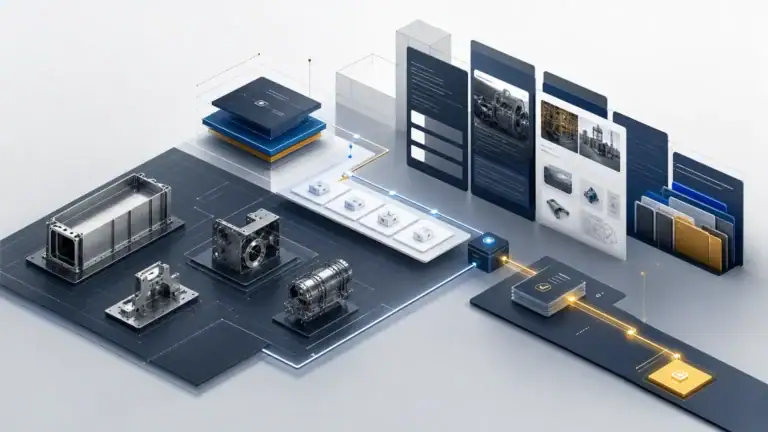

Lead generation for manufacturers is not a race to collect the most form submissions. It is a system for helping the right industrial buyers understand a capability, verify technical fit, and start a conversation that sales and engineering can use.
A useful manufacturing inquiry often includes more than a name and email address. Application, material, volume, timing, constraints, buying role, and next step may all matter. The website, technical content, acquisition channels, qualification rules, and follow-up process therefore need to work together.
All illustrations in this article, including the featured image, are AI-generated and do not depict any real facility, customer, or result.
Key takeaway
A serious manufacturing system does not promise “more leads” in the abstract. It defines which companies, projects, and signals deserve sales attention, then builds a buyer journey that makes those signals visible.
What counts as a qualified manufacturing lead?
A B2B lead is a company or professional contact showing identifiable interest. In industrial sales, that interest is not yet an opportunity. Separate four levels:
- Relevant visitor: views a capability, application, product, or resource connected to your market.
- Identifiable contact: requests a document, asks a question, or completes a form.
- Qualified lead: the company, need, and timing fit your target well enough to justify review.
- Sales opportunity: a next step is accepted and the team can evaluate the project.
This distinction prevents traffic, contacts, and revenue opportunities from being treated as the same thing. Industrial buying often involves research, technical evaluation, and several stakeholders before a decision.[1]
The six building blocks of a manufacturing lead generation system
1. An ideal customer profile specific enough to exclude
Describe the accounts you can serve well: industries, company size, regions, applications, volumes, technologies, requirements, and buying triggers. Add explicit exclusions such as orders below your operating threshold, incompatible timelines, unsupported markets, or requests outside your capabilities.
The profile should guide website language, examples, forms, campaign targeting, and qualification rules. If it exists only in a slide deck, it cannot improve the buyer journey.
2. Pages that make technical fit verifiable
A buyer cannot qualify your company from generic claims. Useful pages explain capabilities, applications, materials, constraints, industries served, authorized proof, processes, and contact paths. AUTOM7’s guide to manufacturing website design and SEO explains how those elements support supplier evaluation, while its manufacturing website examples show several public patterns without treating them as a ranking.
Do not present an unverified certification, an unauthorized customer logo, or a stock image as evidence of a real facility. A limited but authentic proof set is more useful than a large ambiguous display.
3. Content tied to buying questions
Technical content can answer questions about selection, compatibility, sizing, maintenance, quality, or comparison. Thomas identifies persona targeting, useful guides, and content distribution as common components of lead generation programs for manufacturers.[2]
The goal is not to publish on every adjacent topic. Google recommends people-first content that is original, complete, clearly sourced, and useful to the site’s real audience.[3] For a smaller manufacturer, a focused set of decision-support resources is usually more defensible than mass-produced content.

4. Channels selected by intent
SEO captures active research. Trade shows create direct conversations. Targeted outreach opens doors with selected accounts. Paid media accelerates a bounded test. Industrial directories improve visibility for specific categories. No channel can permanently compensate for a poorly explained offer or an inconsistent follow-up process.
| Channel | Primary role | Signal to measure | Common risk |
|---|---|---|---|
| SEO and content | Capture active research | Qualified inquiries by page | Traffic disconnected from the offer |
| Targeted outreach | Reach selected accounts | Relevant replies and meetings | Generic volume and compliance gaps |
| Paid media | Test an angle quickly | Cost per qualified inquiry | Optimizing clicks instead of opportunities |
| Trade shows and networks | Build direct trust | Accepted sales next steps | Contacts left untouched after the event |
5. A form that prepares the conversation
Ask only for information that changes the next step: company, role, need, timeline, rough scale, or a relevant file. A very short form may create opaque inquiries. A very long form may repel buyers who are still exploring.
Offer more than one path when the sales process justifies it: an RFQ for a defined requirement, a scoping conversation for a complex project, and a useful resource for early research. Each path should explain what happens next.
6. Qualification and follow-up led by people
Automation can acknowledge receipt, create a record, enrich permitted business data, assign an owner, and trigger reminders. It should not independently decide that a complex project is viable or send risky technical answers. The rules support the team; they do not replace judgment.
Use a short review grid: account fit, real need, potential value, feasibility, timing, contact authority, and next action. A rejected inquiry also needs a clear disposition such as outside target, nurture, revisit later, or refer elsewhere.

Which metrics expose real progress?
Connect every inquiry to its source, entry page, and sales outcome. Then separate three measurement levels:
- Acquisition: relevant impressions, visits to strategic pages, and returning buyer activity.
- Qualification: complete inquiries, target accounts, and technically feasible projects.
- Sales: meetings held, relevant quotes, opportunities created, and documented loss reasons.
Raw lead volume can increase while quality declines. One of the most useful signals is the share of inquiries that move to a real next step, followed by the reasons the remaining inquiries do not.
A practical 90-day implementation plan
- Days 1–15: define the target, exclusions, buying triggers, and a shared qualified-lead definition.
- Days 16–35: inventory pages, proof, resources, forms, and available data. Fix the major obstacles.
- Days 36–60: build one primary journey, one decision-support asset, and one follow-up protocol. Install measurement.
- Days 61–75: launch one bounded channel test with a written hypothesis instead of several campaigns.
- Days 76–90: review inquiries with sales, adjust the criteria, and decide whether to continue, change, or stop.
This sequence reduces the risk of buying traffic before the website, proof, and follow-up system are ready. AUTOM7 works the same way: understand the offer, the market, the existing site, and the buyer path before proposing a larger system.
B2B outreach and personal data: what to settle first
Outreach rules depend on the market, recipient, data source, and channel. Teams contacting professionals in France should note that the CNIL distinguishes prospecting toward consumers, which generally requires prior consent, from prospecting toward professionals. In the B2B case, it states that legitimate interest may be used when the message relates to the recipient’s profession. The recipient must be informed, be able to object simply and free of charge, identify the sender, and refuse further messages.[4] Teams selling into other markets should apply the national rules governing their own audience rather than assume a single common standard.
This is not a substitute for market-specific legal review. It is a reminder to design data sourcing, identification, preference handling, and suppression rules before scaling a campaign.
Checklist before increasing spend
- The target and exclusions are written and shared by marketing and sales.
- Pages answer technical questions before the contact step.
- Proof is real, authorized, and placed near the related claim.
- Every form explains the next step and collects only useful information.
- Sources, campaigns, and entry pages are connected to inquiries.
- A person reviews important inquiries and technical responses.
- Loss and rejection reasons are recorded.
- Market-specific outreach and opt-out rules are enforced.
Frequently asked questions
What is the difference between a lead and a manufacturing opportunity?
A lead shows identifiable interest. An opportunity has been reviewed, fits the target well enough, and has an accepted commercial next step.
Should a manufacturer start with SEO, paid media, or outbound?
Start with the channel that can test the strongest business hypothesis within a bounded budget and period. Prepare the site, proof, and follow-up before increasing volume.
How many fields should an industrial RFQ form contain?
There is no universal number. Ask for the information required to select the next step, then match the form to project maturity and complexity.
Can AI qualify manufacturing leads automatically?
AI can structure and summarize signals, but important projects, technical constraints, and sales decisions should remain under human supervision.
Which metric should a manufacturer review first?
Review the share of inquiries that fit the target and move to a real next step, not only the number of forms submitted.
Does your website attract the right manufacturing projects?
Review the clarity of your pages, proof, and inquiry path before adding more traffic.