

A pool builder portfolio should do more than collect attractive photographs. Its job is to help a homeowner recognize a project similar to their own, understand how you work, and know what to do next.
A finished pool photographed at sunset may catch the eye, but it does not explain whether the project involved new construction, a difficult site, a renovation, or specialized equipment. Without context, a photograph inspires. A well-documented project page turns that image into credible sales proof.
Key takeaway
An effective pool builder portfolio combines accurate photographs, real project context, site constraints, publishable technical choices, and a clear next step. Twelve well-documented projects are usually more useful than fifty unexplained images.
A pool builder portfolio should help homeowners decide
Prospective customers are not only checking whether you build attractive pools. They are trying to reduce uncertainty. Have you worked on a sloping lot? Do you handle major renovations? Can you integrate a cover, patio, or equipment area into a coherent outdoor space? Do you actually serve their location?
A strong portfolio answers these questions without turning every project into an exhausting technical report. It shows the result, then gives enough context for the reader to understand the value of the work.
This approach builds on the principles of pool builder website design: your service pages explain what you offer and how prospects can contact you, while project pages provide the evidence that makes those promises credible.
A gallery and a portfolio serve different purposes
A gallery is useful for browsing images quickly. A portfolio adds a layer of understanding: project type, initial request, constraints, selected solution, and visible outcome. Both formats can coexist. The gallery helps visitors explore; the project page helps them decide.
The 10 elements of a convincing project page
Use a consistent structure from one project to the next. Homeowners can compare projects more easily, and your team spends less time deciding how to present each one.
- A specific title: identify the pool type, the nature of the work, and the general location when you are allowed to publish it.
- The initial request: explain what the customer wanted, using their own words only when you have permission.
- The context: new construction, renovation, equipment replacement, landscape work, or restoration.
- The real constraints: access, slope, available space, soil, timing, architectural integration, or maintenance requirements.
- The selected solution: describe the choices that addressed those constraints.
- The scope of work: state what your company completed and what other contractors handled.
- The key photographs: include an overview, useful details, and construction stages when they add information.
- Trust signals: show the team, method, inspections, handover, or an authorized customer review only when these elements are real and publishable.
- The project limits: make clear that one completed pool does not promise an identical result on every property.
- The next step: invite the visitor to discuss a project, request a feasibility review, or ask for an initial assessment.
Do not fill information gaps with vague language. If a timeline, budget, or result cannot be verified, leave it out. Modest and accurate proof is more persuasive than a dramatic claim you cannot support.
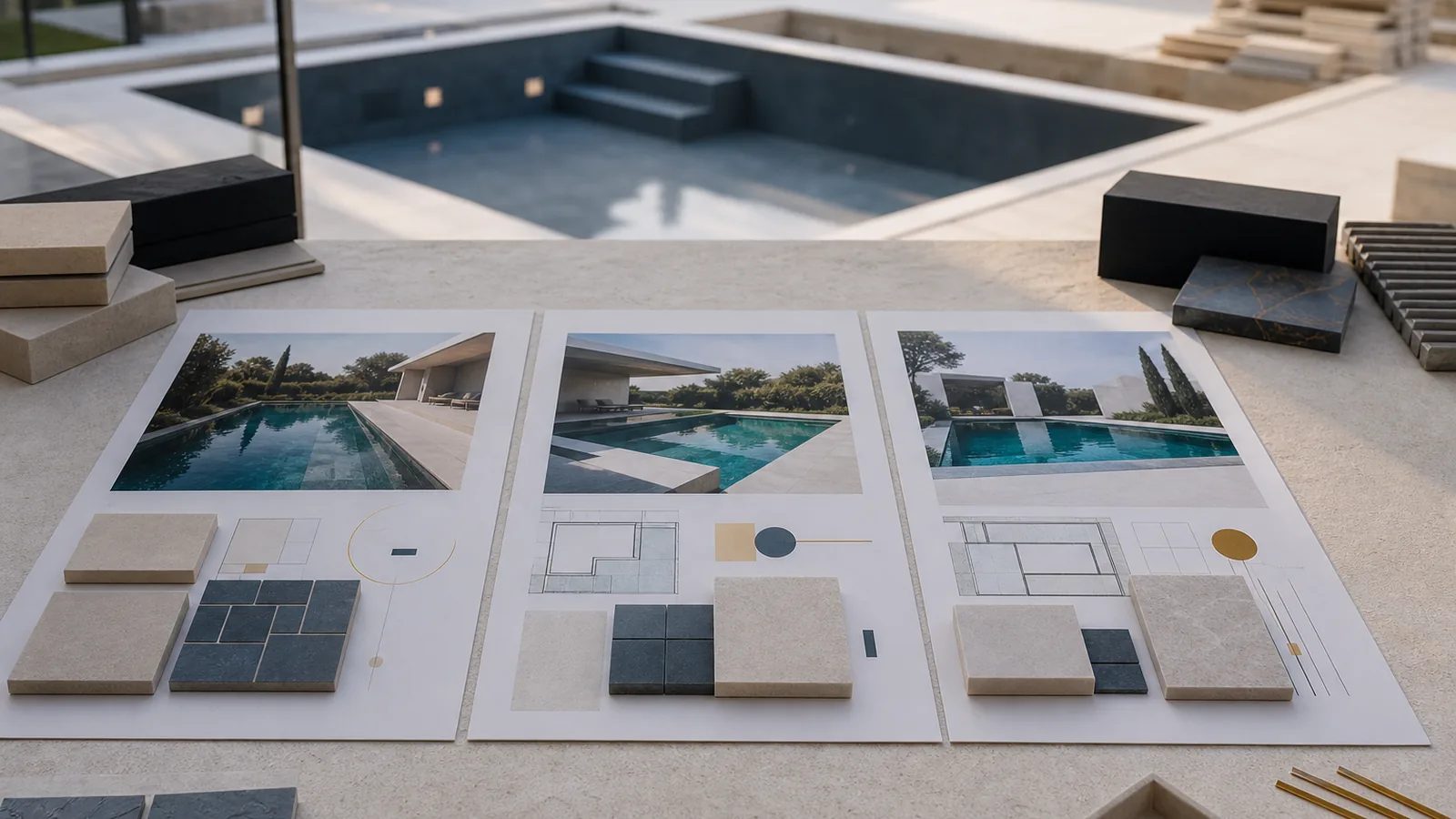
Plan photographs that show the work clearly
Useful project photography does not depend only on expensive equipment. A consistent series taken with a recent phone can explain more than one highly edited image. The goal is to help the visitor understand the project.
A practical shot list
- an overall view of the pool and its surroundings;
- an angle showing how the pool fits the property or home;
- a close-up of a finish, feature, or piece of equipment;
- a construction-stage image that explains a real constraint;
- comparable before-and-after views for renovation work;
- one horizontal image suitable as the main project image and several vertical crops for social media.
Avoid filters that substantially change the color of the water, finish, or materials. Google’s official guidance recommends well-lit, in-focus photographs that represent reality and are not excessively altered.[1] These principles are useful beyond a Google Business Profile: prospective customers need to trust what they see.
Permission and privacy
Obtain written permission that identifies the intended uses, such as your website, social media, advertising, or sales portfolio. Remove people, license plates, house numbers, and other identifying details when they are unnecessary. The French data protection authority (CNIL) explains that an identifiable person can request the removal of an image published online and describes the steps available in France.[2] Requirements differ by country, so confirm the rules that apply where the project and customer are located.
This check protects the homeowner as well as the pool builder. It also reduces the risk of having to rebuild a project page or remove campaign material after publication.
Organize projects without building a complicated catalog
Categories should reflect how prospective customers choose, not your internal organization. Three to six starting points are often enough:
- new pool construction;
- renovation and remodeling;
- small yards or difficult access;
- infinity pools or unusual shapes;
- equipment, covers, and heating;
- complete outdoor-living projects, when that work genuinely belongs to your offer.
Avoid adding a filter for every technical detail. An overly complex navigation creates nearly empty categories and forces visitors to understand your internal terminology. Start simply, then add a filter only when several projects justify it.
One page per project or one large gallery?
Strategic projects deserve a dedicated page when they tell a distinct story: a complex renovation, difficult access, architectural integration, or specialized equipment. Simpler work can remain in a captioned gallery.
The useful question is not “How many pages should we create?” It is “Does this project answer a specific concern a future customer may have?” If it does, a dedicated page can support your sales team, local visibility, and homeowners comparing several pool builders.
Turn a completed project into credible proof
A final photograph proves that a pool exists. On its own, it does not prove the quality of the advice, the handling of a constraint, or the follow-up during construction. Make each claim more useful by connecting it to something visible or verifiable.
| Weak claim | More useful proof |
|---|---|
| “Luxury project” | Materials, finishes, and design choices explained without inventing a price |
| “Complex build” | The access, site, or renovation constraint described specifically |
| “Happy customer” | An exact, authorized review connected to the relevant project |
| “Fast work” | The real timeline, when it is relevant and verified |
| “Custom solution” | A choice tied to an identifiable request or constraint |
The project description does not need to be long. Two or three precise paragraphs are often enough. Remove adjectives that the photographs or facts do not support.
Make the portfolio useful for local search
A project page can help search engines understand your services and service area when the information is natural and accurate. The town or city, type of work, and services provided can appear in the page title and project description when those details are correct and authorized.
Do not repeat a list of cities or force “pool builder + city” into every paragraph. The page should first help a homeowner evaluate your work. Search visibility supports that reading; it should not replace it.
Each project page should connect to:
- the relevant service;
- the area you actually serve;
- a related or complementary project;
- the page for requesting an assessment or starting a conversation.
A structured portfolio also strengthens the pool builder lead-generation process: the project a visitor reads provides useful context before the first conversation.
Connect each project to a relevant quote request
A visitor who reaches the end of a project page has just seen an example related to their needs. Offer a specific next step. “Discuss my renovation,” “Review my property,” or “Check project feasibility” gives more context than a generic “Contact” button.
The inquiry form can record which project the visitor viewed. Your team then knows what prompted the request and can prepare a more relevant conversation. Ask only for information needed at the first stage: general location, project type, expected timing, contact details, and an open message. A detailed technical assessment can follow.
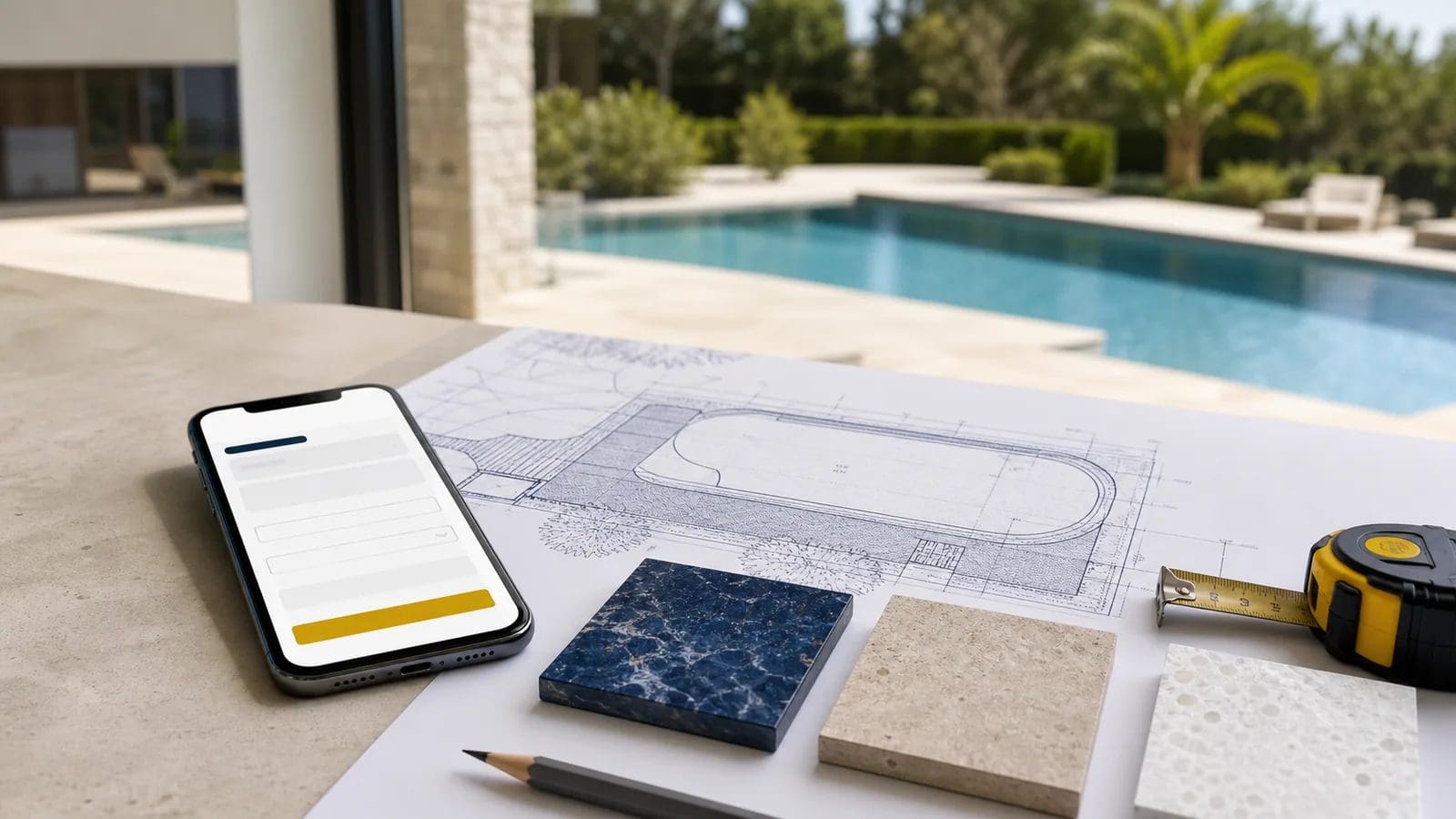
Track the journey from the project page to the inquiry and through qualification. Page views alone cannot show whether a portfolio creates suitable opportunities. A less-visited project can still prepare better conversations than a popular photograph with no next step.
Use a simple process after every completed project
The main obstacle is rarely page design. The useful information often remains across several phones, team messages, and the project manager’s memory. A small repeatable process preserves it.
- Before handover: confirm permission for photography and publication.
- On site: follow the shot list and record the context and constraints while they are still fresh.
- After completion: shortlist ten to fifteen images, then keep only those that explain the project best.
- With the team: verify technical terms, completed work, and the limits of what may be claimed.
- Before publication: compress images, write useful alt text, and check the page on mobile.
- After publication: connect the project to the relevant service and test the inquiry journey.
You can begin with a shared folder and a standard project sheet. Automation becomes useful once the steps are stable: renaming images, preparing a project record, requesting approval, or flagging completed work that has not yet been documented. It should never publish unverified customer proof without human review.
Checklist before publishing a pool project
- Written permission covers the intended channels.
- People and private information are removed or explicitly authorized.
- The project type and general location are accurate.
- The described services match your company’s actual scope.
- Photographs are clear, accurate, and optimized for the web.
- Alt text describes each image without keyword stuffing.
- Any testimonial is exact, authorized, and attached to the correct project.
- The page links to a relevant service and a clear next step.
- The inquiry journey works on desktop and mobile.
- Your analytics can identify inquiries that started from the portfolio.
If several items are missing, keep the project in preparation. A portfolio should build confidence; an incomplete or exaggerated page produces the opposite effect.
Make completed projects part of the sales process
The best portfolio does not try to impress everyone. It helps suitable prospects recognize your expertise, understand your method, and describe their own project more clearly.
If your website already contains dozens of photographs with no structure, start with three representative projects. Document them accurately, connect them to the right services, and measure the conversations they support. AUTOM7 can provide a free website audit to identify underused proof, gaps in the quote-request journey, and the first practical improvements.
Frequently asked questions about pool builder portfolios
How many projects should a pool builder portfolio include?
Start with six to twelve well-documented projects. Variety and accuracy matter more than volume. Add a project when it demonstrates a different service, constraint, or important service area.
Does every completed pool need its own page?
No. A dedicated page is useful when the project answers a specific question or demonstrates a distinct capability. Simpler images can remain in a captioned gallery connected to your service pages.
Can you publish photographs taken at a customer’s property?
Obtain written permission for the intended uses and remove unnecessary identifying details. Rules differ by location, so confirm the applicable privacy and image-use consent requirements before publication.
Which photographs are most useful for a pool renovation?
Use comparable before-and-after views, construction stages that explain the difficulty, an overall view, and close-ups of relevant finishes. The reader should understand what changed, not only see the final result.
Can a portfolio support a pool builder’s local SEO?
Yes, when each page accurately describes a real project, the service provided, and an authorized location, with links to the relevant service and inquiry pages. A gallery with no context offers much less useful information.
How can you tell which portfolio projects generate inquiries?
Track clicks to the inquiry form, the project viewed before submission, and the quality of the resulting conversation. Page views alone are insufficient because a lower-traffic project may still produce better-fit requests.
Review your website before deciding what to improve
Start with a free assessment of the visible obstacles in your website and enquiry journey.
For businesses with 5 to 40 employees. Free, with no obligation.
Sources
- Google Business Profile Help — Tips for business-specific photos on your Business Profile.
- CNIL — Demander le retrait de votre image en ligne (French guidance on requesting removal of an image published online).